A practical guide to nursery textiles
Nursery Bedding: What to Consider When Choosing a Baby’s First Layer
A baby’s first bedding layers should be soft to the touch, breathable, correctly sized, and simple to keep clean. But for an infant’s sleep space, appearance and fabric preference come second to safe-sleep guidance: loose blankets, quilts, pillows, and other soft items should stay out of the crib.
Published November 6, 2026
A nursery can feel like a small landscape being prepared for a new arrival: a mattress fitted into its frame, clean fabric folded within reach, the room gradually arranged for quieter nights. It is tempting to begin with color or texture. Yet the most useful questions are practical ones. Does the sheet fit tightly? Can it be washed often? Does the fabric suit the room’s temperature and the family’s routine? And, most importantly, is the sleep space arranged according to current pediatric safe-sleep recommendations?
For an infant, “bedding” does not mean a miniature version of an adult bed. The safe sleep surface is deliberately spare: a firm, flat mattress with a fitted sheet, with the baby placed on their back and the sleep space kept clear of loose objects. A soft blanket may look like a natural first layer, but loose blankets and other soft items can create serious hazards. Warmth should be managed through appropriate clothing or wearable sleep garments rather than loose coverings.
Beyond that essential boundary, nursery textiles still matter. Fabric touches delicate skin, absorbs spills, passes through frequent laundry cycles, and must retain its shape after repeated use. Understanding fiber, weave, fit, and care can help caregivers choose sensibly without confusing a soft hand or a “natural” label with a guarantee of safety.
Start with the sleep space, not the decoration
Before selecting sheets or accessories, check the crib or other approved infant sleep product and its manufacturer’s instructions. Use a mattress designed for that specific product, and make sure it fits securely, without gaps at the edges. The sheet should be made for the mattress dimensions and should stay taut when installed. A sheet that bunches, slips off a corner, or leaves excess fabric is not a suitable fit.
Current safe-sleep recommendations from recognized pediatric and public-health authorities should guide the setup. In general, the infant sleep surface should be firm, flat, and level, with only a fitted sheet. Keep pillows, comforters, quilts, loose blankets, bumpers, soft toys, and positioners out of the sleep area. These recommendations apply even when an item is marketed for a nursery or described as breathable, organic, hypoallergenic, or specially designed for babies.
Caregivers should consult their child’s health professional and the latest guidance from their local pediatric or public-health authority, especially when a baby has medical or developmental needs. Advice may vary by circumstance, and safe-sleep recommendations can be updated. A product description is not a substitute for medical guidance or for instructions supplied with the crib and mattress.
Choosing fabric: fibers are only part of the story
Natural fibers such as cotton are common in nursery sheets because they are widely available, familiar to wash, and offered in a broad range of weaves and weights. A cotton label alone, however, does not tell you how the finished fabric will feel or perform. Construction, finishing, thickness, fit, and laundering all contribute to the experience.
A lightweight, closely woven cotton can feel smooth and be straightforward to care for. Jersey cotton has a knit structure and a softer, T-shirt-like hand; percale is generally crisp and woven; flannel is brushed for a warmer, napped surface. These descriptions refer to fabric construction and finish, not to infant sleep safety. Whichever fabric you choose, the fitted sheet must remain secure and the sleep area must stay free of loose bedding.
Some families consider blends or other fibers, including linen or bamboo-derived fabrics. Those materials differ in texture, moisture handling, durability, and care requirements. Marketing terms may describe a fiber source or finish, but they do not necessarily establish how a finished textile behaves in a particular room or on a particular mattress. Read the fiber-content label and the care instructions rather than relying on a single broad claim.
Softness is also a personal and changing impression. A fabric that feels exceptionally smooth in the shop may require more careful washing, while a sturdier sheet may become more comfortable with use. Avoid assuming that a delicate or silky surface is inherently better for a baby. The priority is a well-fitting, clean sheet on the appropriate mattress—not a particular level of sheen, price, or luxury.
Breathability and room comfort
“Breathable” appears frequently in descriptions of bedding, but it is not a complete safety assessment. Airflow through fabric depends on the fiber, yarn, weave or knit, thickness, and finish. A light textile may feel cooler than a dense one, but no fabric label can make an unsafe sleep setup safe. A breathable blanket remains a loose blanket if it is placed in an infant’s sleep space.
Room temperature, the baby’s clothing, and the warmth of any approved wearable sleep garment all influence comfort. Rather than adding a loose cover, follow pediatric guidance on dressing the baby for sleep and avoid overheating. Caregivers can check the room and the baby’s comfort using advice from their health professional; avoid relying on a blanket to correct a room that is too cold or too warm.
Textiles can contribute to a comfortable environment, but they cannot regulate a baby’s temperature in a predictable way on their own. Claims that a fabric “keeps babies at the perfect temperature” should be treated cautiously. A nursery’s comfort comes from the whole setup, including room conditions, suitable clothing, a safe sleep surface, and attentive caregiving.
Fit is a safety and usability issue
Measurements are more useful than assumptions. Check the mattress label and the sheet packaging, and confirm that the sheet is intended for that exact size and type of mattress. A fitted sheet should stretch over the corners and lie smooth across the surface without pulling free. Do not try to make an oversized sheet work by tucking extra material under the mattress, and do not use a sheet that is too small or difficult to secure.
Mattress thickness and shape matter as well as length and width. A sheet designed for one mattress profile may not fit another, even when the basic dimensions look similar. If the crib or mattress has a manufacturer’s fit guidance, follow it. After changing or laundering a sheet, check that every corner is still secure and that the surface remains flat.
It is useful to keep a small number of correctly sized fitted sheets available so a soiled one can be replaced promptly. Having a backup is a practical convenience, not a reason to add extra layers to the sleep surface. Spare sheets should be stored outside the crib until needed.
Laundry: frequent, gentle, and label-led
Infant textiles may need frequent washing because of spit-up, diaper leaks, drool, and everyday spills. Before the first use, launder sheets according to the manufacturer’s instructions. Check the label for water temperature, detergent guidance, drying method, and any warnings about bleach or fabric softener. These details can differ among products, even when they share a fiber type.
Use enough detergent to clean the fabric, but avoid assuming that strongly scented products are necessary. If a baby’s skin seems irritated, discuss the concern with a health professional and consider whether detergent, residue, clothing, or another factor could be involved. A “sensitive” or “natural” label is not a guarantee that every person will tolerate a product; individual reactions vary.
Wash soiled items promptly when practical, and separate heavily soiled laundry when needed to reduce transfer to other fabrics. Follow the care label rather than using high heat by default. Excessive heat, harsh washing, or an overloaded machine can shorten a textile’s useful life, damage elastic, or affect its fit. A fitted sheet that has stretched, torn, or lost its grip should be replaced.
Keep the crib clear while the baby sleeps, including during laundry changes. If a sheet becomes wet or soiled, move the baby to a safe place while changing it, then make sure the replacement is dry, fitted, and secure before returning the baby to the sleep space.
Durability, labels, and meaningful claims
A nursery sheet is a workaday textile. Its value is measured less by how elaborate it looks than by whether it continues to fit, withstand washing, and feel comfortable after repeated use. Examine seams and elastic, read the washing instructions, and consider whether the fabric’s maintenance demands fit the household routine.
Certifications can provide information about defined aspects of production or testing, but they should be read precisely. A certification for a textile does not necessarily certify that the item is suitable for every sleep environment, that it prevents allergies, or that it meets every possible safety requirement. Look for the name of the certifying organization, the scope of the claim, and the product or component covered. If a claim is vague, seek clarification rather than treating it as proof of a health benefit.
Likewise, terms such as “hypoallergenic,” “chemical-free,” and “non-toxic” can be used in ways that are difficult to compare. No ordinary fabric can guarantee that a child will never react to it, and “chemical-free” is not a precise description of a textile. Consider clear fiber and care information, transparent testing details where relevant, and the fit and condition of the finished product.
What belongs in the crib as a baby grows?
Families often wonder when a blanket, pillow, or comforter can be introduced. There is no need to rush. Follow the most current pediatric guidance for the child’s age and development, and ask a health professional if the situation is not clear. Recommendations for older children are not interchangeable with recommendations for infants.
For an infant, keep the sleep area free of loose bedding and soft objects. A wearable sleep garment may be an option when used according to its instructions and appropriate guidance; it should not be weighted unless a qualified health authority specifically advises otherwise. Do not add a loose blanket over a wearable garment. If the child begins showing signs of rolling, stop using any swaddling method that restricts the arms and follow current pediatric guidance on safer alternatives.
As a child develops, sleep arrangements change, but a product’s appearance or marketing age range should not determine the transition. Consult the crib manufacturer’s limits and pediatric advice, and use a sleep space designed for the child’s stage. The safest choice is the one that follows current recommendations, not the one that completes a decorative set.
A restrained approach to nursery textiles
Nursery design often rewards restraint. A calm palette, a few washable textiles, and a clear sleep surface can be both practical and welcoming. Decorative quilts and throws can be used outside the sleep space—for example, folded over a chair or kept for supervised use when the baby is awake—then removed before sleep. Their presence in the room does not mean they belong in the crib.
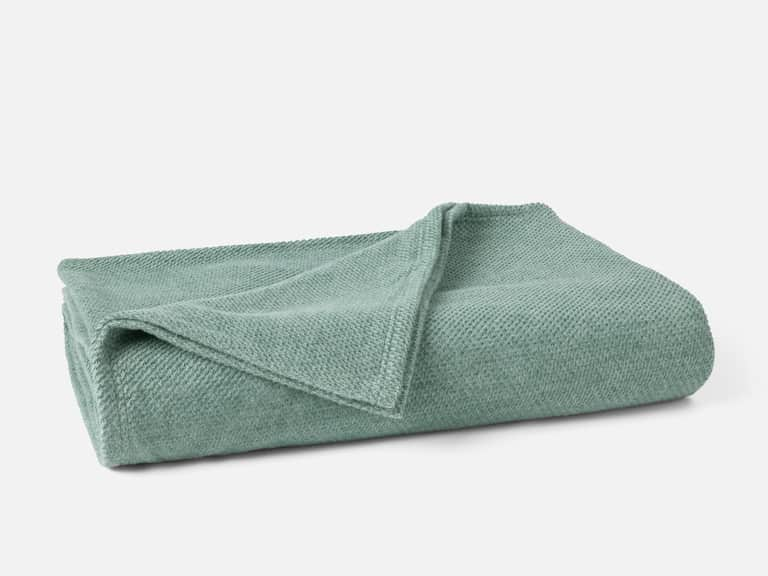
When selecting a blanket for later supervised use or for a shared living space, evaluate it by composition and care rather than assuming all blankets perform alike. For example, the Sequoia Washable Organic Cotton and Wool Blanket is described as a blend of 70% organic cotton and 30% organic wool, with gentle machine-wash instructions. That information may help an adult assess its material and maintenance needs, but it does not make the blanket appropriate as loose infant sleep bedding. It should remain outside the infant’s sleep area.
This distinction is important: a textile can be useful in a home without being suitable for every person, age, or use. “Nursery” is a room label, not a safety certification. Keep decorative and adult bedding separate from the baby’s sleep surface.
A practical checklist for a baby’s first bedding layer
- Use a firm, flat mattress intended for the crib or approved sleep product.
- Choose a fitted sheet specified for that mattress’s dimensions and profile.
- Check that the sheet lies taut, stays securely in place, and has no tears or stretched elastic.
- Keep pillows, quilts, loose blankets, bumpers, toys, and other soft objects out of the infant sleep space.
- Manage warmth through suitable clothing or an appropriate wearable sleep garment, following current pediatric guidance.
- Wash new and soiled textiles according to the care label; avoid improvised treatments that could damage fit or fabric.
- Review product claims carefully and do not treat “natural,” “breathable,” or “hypoallergenic” as a substitute for safe-sleep practices.
- Check current guidance from a recognized pediatric or public-health authority and ask a health professional about individual concerns.
The first layer is a small, considered choice
The simplest nursery sheet may do the most important work: fitting the mattress, staying smooth, and surviving frequent washing. Fabric preference matters, but it is secondary to a secure fit and a clear sleep space. Cotton and other fibers can each be considered on their own merits; no single material is a substitute for careful construction, accurate sizing, and sensible care.
In the end, a baby’s first bedding layer is not a blanket of softness around the child. It is a fitted sheet over a safe mattress, chosen with attention to its dimensions and maintenance, within a sleep environment shaped by current pediatric advice. Everything else can wait until it is appropriate—and can be enjoyed elsewhere in the room in the meantime.
This article offers general educational information and is not medical advice. Safe-sleep recommendations may change; consult current guidance from a recognized pediatric or public-health authority and speak with your child’s health professional about individual circumstances.